
Blog · Specification
What aluminum fin stock is and how to choose alloy and gauge

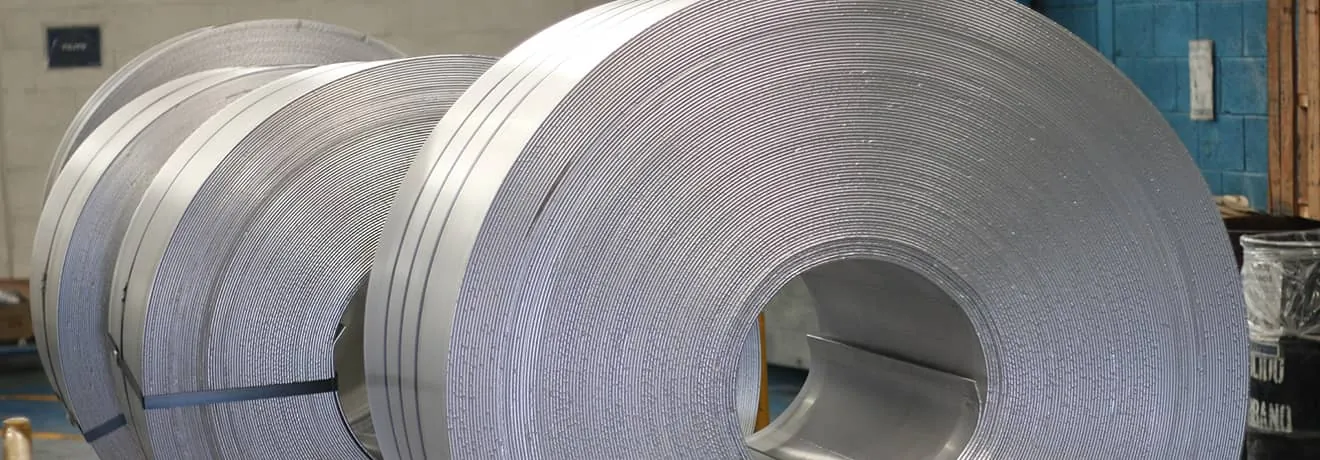
Fin stock is aluminum rolled to 0.0039 to 0.010 in used to make the fins of evaporators, condensers, radiators and coils. It is specified by alloy (1100 for conductivity, 7072 with zinc for cathodic protection of the tube), gauge, temper by fin press speed and strip width. A gauge variation breaks the fin and stops the line. Almexa rolls 1100 and 7072 fin stock from 1 to 48 in wide in Mexico. Source: Almexa 2021 catalog; plant practice.
In a heat exchanger the tube carries the refrigerant and the fins do the work: they multiply the contact surface with air. Those fins are stamped and corrugated at high speed from a very thin aluminum strip: fin stock.
What it is
Cold-rolled aluminum at 0.0039 to 0.010 in, supplied in narrow coils (from 1 in up) with a 3 or 6 in core. Aluminum is used for its thermal conductivity, its corrosion resistance and its weight: an aluminum fin weighs a third of a copper one at equal surface.
Alloy: 1100 or 7072
| Alloy | What it brings | When to use it |
|---|---|---|
| 1100 | Maximum thermal conductivity and formability | Units in benign environments where thermal performance matters most |
| 7072 | Zinc that turns the fin into a sacrificial anode | Humid, saline or industrial environments; exchangers with copper tube |
In an exchanger with copper tube and aluminum fin, the fin corrodes first; with 7072 that corrosion is controlled and protects the tube. It is the difference between a unit that lasts and one that leaks.
Gauge and temper
Gauge is chosen by fin design and unit weight: 0.004 to 0.006 in in residential and commercial, up to 0.010 in in industrial and radiators. Temper depends on the fin press: a high-speed machine needs a temper that forms the collar without tearing and without leaving the fin loose. Lowering gauge without adjusting temper is the fastest way to fill the floor with broken fins.
What fails when the strip isn't consistent
- Gauge variation along the coil: collars come out at different heights and the tube doesn't expand evenly.
- Poor flatness: the strip waves and jams in the feed.
- Residual oil: the fin doesn't lubricate evenly and scratches.
- Burred edges: coil slit out of tolerance.
All of that is controlled at the cold mill and in slitting, with in-line gauge measurement. It is the reason fin stock is bought from a mill and not a distributor.
How to specify it
- Alloy and temper.
- Nominal gauge and tolerance.
- Strip width and slitting tolerance.
- Core (3 or 6 in) and maximum outside diameter (24 in at Almexa).
- Fin type and fin press speed.
- Monthly program, with peak season marked.
Seasonality
Air conditioning manufacturers buy fin stock ahead of the cooling season, in the first quarter. Reserving capacity with the mill in the prior year's fourth quarter avoids running out of strip in March.
Frequently asked questions
What is fin stock?
Aluminum rolled to 0.0039 to 0.010 in, in coils, used to make heat exchanger fins: evaporators, condensers, radiators and coils.
When should 7072 fin stock be used?
In corrosive environments or when the tube is copper: the zinc in 7072 turns the fin into a sacrificial anode and protects the tube. In benign environments, 1100 gives better conductivity.
What is the narrowest fin stock Almexa makes?
1 in (25.4 mm), up to 48 in, with a 3 or 6 in core.

Leads Almexa Aluminio, Mexico's integrated flat-rolled aluminum mill. Writes about alloys, process, pricing and supply for industrial buyers in North America. LinkedIn