
Blog · Process
How flat-rolled aluminum is made: from ingot to coil

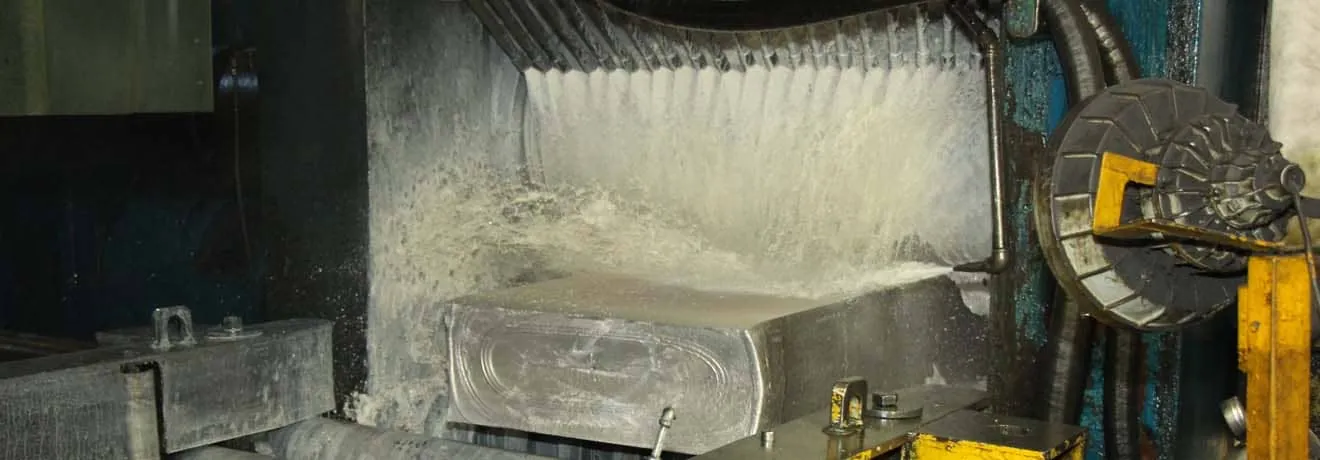
Flat-rolled aluminum is made in five stages: melting ingot and scrap, casting into slab (DC) or strip (CC), hot rolling, cold rolling with intermediate anneals, and slitting or conversion. Direct-chill casting produces 12 in slabs that are hot rolled and gives better mechanical properties; continuous casting produces 0.25 to 0.3 in strip that goes straight to cold rolling. Almexa runs both processes in Mexico, at Cuautitlán Izcalli, Ecatepec and Veracruz. Source: Almexa plant process, September 2026.
When a buyer says "aluminum supplier", it can mean three different things: a mill that makes the metal, a service center that cuts it, or an importer that ships it. Knowing how it is made is the way to know which one you are buying from.
Melting
Everything starts in the furnace. Primary aluminum ingot and sorted scrap are charged, melted at about 1,300 °F and the chemistry is adjusted with each alloy's elements: manganese for the 3000 series, magnesium for the 5000, iron and silicon for the 8000. The bath is degassed to remove hydrogen and filtered to remove oxides. The defects that show up months later on the customer's line, like pinholes in foil or tears in a draw, are almost always born here.
Casting: direct-chill or continuous
There are two paths. In direct-chill (DC) casting, liquid metal is poured into a mold with a descending bottom while cold water solidifies it; out comes a slab about 12 in thick weighing several tons. In continuous casting (CC), metal passes between cooled rolls or belts and comes out as a 0.25 to 0.3 in strip ready for cold rolling.
| Direct-chill (DC) | Continuous casting (CC) | |
|---|---|---|
| Output | Slab, ~12 in | Strip, 0.25 to 0.3 in |
| Next step | Hot rolling | Cold rolling |
| Mechanical properties | Better and more uniform | Adequate for soft alloys |
| Typical alloys | 3xxx, 5xxx, demanding products | 1xxx, soft 3xxx, foil |
| Who has it in Mexico | Almexa (Cuautitlán and Veracruz) | Almexa (Ecatepec) and other producers |
The difference matters when the part demands strength and consistency: a hot-rolled slab has a finer, more uniform grain structure. An integrated mill with direct-chill casting is what separates a manufacturer from a service center, and in Mexico that mill is Almexa.
Hot rolling
The slab is heated to about 930 °F and passes several times through the hot mill until it becomes a strip a few millimeters thick, which is coiled. Much of the final product's metallurgical structure is set here.
Cold rolling
The strip goes through the cold mill in several passes, reducing thickness 30% to 50% each time, down to final gauge: 0.118 in for a stamping plate, 0.020 in for facade sheet, 0.0008 in for blister foil. Between passes it is annealed when the metal work-hardens too much. Final temper (O, H14, H18) comes from combining the last reduction with the final anneal.
Slitting and conversion
The finished coil is slit to width, cut to length, blanked into circles, coil coated or, for foil, printed, lacquered and laminated with polyethylene. Every lot ships with a mill test report: chemistry and mechanical properties measured at the plant.
Why it matters to you as a buyer
- Origin: the country of smelt and cast is what counts for USMCA and Section 232, not where it was slit.
- Quality: whoever melted the metal can answer for a defect; whoever cut it cannot.
- Specification: only a mill sets alloy and temper to your part; a distributor sells what it has.
- Time: without ocean transit, the schedule is set by the plant, and the plant is a truck ride from the border.
If you want to see the process, the Cuautitlán Izcalli plant receives customer visits by appointment, 40 minutes from Mexico City's international airport.
Frequently asked questions
What is an aluminum rolling mill?
A plant that melts the metal, casts it into slab or strip and rolls it to final gauge. It differs from a service center, which only slits and distributes coil made by someone else.
What is the difference between direct-chill and continuous casting?
Direct-chill casting produces thick slabs that are hot rolled and gives better mechanical properties; continuous casting produces thin strip that goes straight to cold rolling and is more efficient for soft alloys.
How long does it take to make an aluminum coil?
The physical process takes days; the real lead time depends on the plant schedule and annealing. Almexa confirms the delivery date in the quote.

Leads Almexa Aluminio, Mexico's integrated flat-rolled aluminum mill. Writes about alloys, process, pricing and supply for industrial buyers in North America. LinkedIn