
Blog · Packaging
Aluminum blister foil: the thickness, alloy and temper a pharma lab asks for

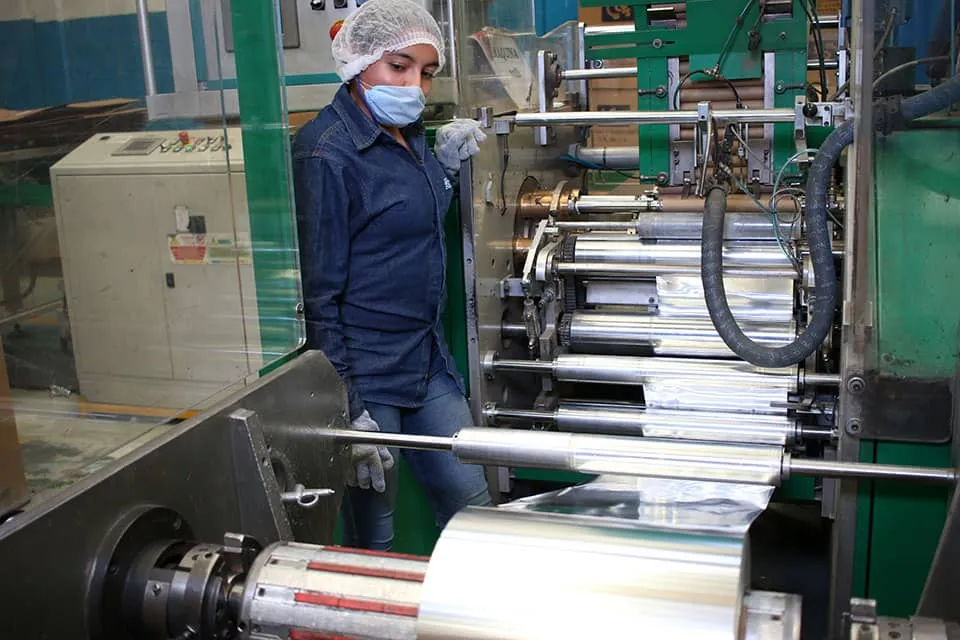
Standard push-through blister foil is 8079 aluminum at 20 microns (0.0008 in) in O temper, with heat-seal lacquer toward the PVC or PVDC cavity and protective varnish with up to six-color printing on the outside. For large cavities or heavy capsules, up to 22 microns in H18 is used. The defects a lab rejects are pinholes, non-uniform sealing and irregular break on push-through. Almexa rolls and converts 8079 foil from 16 to 22 microns in Mexico under FSSC 22000. Source: Almexa 2021 catalog; conversion practice.
A blister is a two-part package: a thermoformed plastic cavity and an aluminum lid the patient breaks with a finger. Everything a lab demands of that lid fits in four words: thickness, alloy, temper and lacquer.
Thickness: 20 microns is the standard
At 20 microns the foil is thin enough to break cleanly when the tablet is pushed and thick enough to have no pinholes. Below 18 microns pinholes appear and let moisture through; above 25 microns the patient struggles to get the tablet out. Almexa makes 16 to 22 microns depending on temper.
Alloy: why 8079
The 8000 series carries iron and silicon, which allow rolling to micron gauges with a very fine grain. 8079 has more ductility than 8011 and rolls thinner with fewer pinholes, which is why it dominates in blister; 8011 is used in lids and laminates where gauge is heavier.
Temper: O or H18
| Temper | Thickness | When |
|---|---|---|
| O (annealed) | 16 to 20 µm | Standard push-through for tablets and capsules; clean break |
| H18 (hard) | 18 to 22 µm | Large cavities, heavy capsules, blisters that must not deform |
Annealing also sterilizes the foil through process temperature, which is why annealed foil reaches the line in clean condition.
Sealing lacquer and printing
Toward the cavity goes a heat-seal lacquer chosen by plastic: PVC, PVDC or Aclar each require different lacquers and a seal with specific temperature, pressure and dwell. Most sealing problems are not the foil's but the foil-lacquer-cavity pairing's. On the outside goes printing, up to six colors, with a protective varnish that resists rubbing in the carton.
What a lab rejects
- Pinholes: detected by light test or in-line inspection; born in rolling or in the metal.
- Non-uniform sealing: incompatible lacquer or sealing parameters.
- Irregular break on push-through: temper or thickness out of spec.
- Stains or residual oil: insufficient annealing.
- Reel diameters out of tolerance: the blister line's unwinder won't accept the roll.
Specifying blister foil
- Thickness and temper.
- Reel width, inside diameter (3 or 6 in) and maximum outside diameter (13.8 in at Almexa).
- Cavity plastic to select the lacquer.
- Artwork, number of colors and varnish.
- Monthly volume in kilograms or meters.
Why convert in North America
Most search results for blister foil are Asian exporters. A lab that buys there adds freight, tariffs, a deposit and two or three months of transit, and audits at a distance. Almexa rolls and converts 8079 foil in the State of Mexico under FSSC 22000, with a mill test report per lot, and hosts the lab's audit at the plant, a short flight from any US or Canadian city.
Frequently asked questions
How thick is the foil in a blister pack?
The standard is 20 microns (0.0008 in) in alloy 8079 and O temper. For large cavities or heavy capsules, up to 22 microns in H18 temper.
What is the difference between 8011 and 8079 foil?
Both are 8000-series alloys. 8079 is more ductile and rolls thinner with fewer pinholes, so it is used in blister; 8011 is common in lids and heavier laminates.
Does Almexa make blister foil in Mexico?
Yes. It rolls and converts 8079 foil from 16 to 22 microns, printed up to six colors and with heat-seal lacquer, at its plants in the State of Mexico, under FSSC 22000.

Leads Almexa Aluminio, Mexico's integrated flat-rolled aluminum mill. Writes about alloys, process, pricing and supply for industrial buyers in North America. LinkedIn